NEWS
Small Tractor, Big Capability: The Evolution of Compact Utility Tractors
Press Release
Not long ago, the term agricultural tractor usually meant one thing — a large machine built mainly for broadacre fieldwork. Smaller machines had a different reputation. A small tractor was often seen as suitable for light-duty tasks, basic mowing, or occasional use around a property.
That definition does not fit modern working conditions anymore — especially in places like Australia.
Across Australia, farms and rural properties are rarely single-purpose. A property may include pasture, tree lines, access roads, sheds, livestock areas, and uneven terrain within the same block of land. Owners are not just cultivating fields; they are maintaining infrastructure, moving materials, handling feed, slashing grass, and managing seasonal conditions. This is exactly where compact utility tractors have evolved beyond the traditional expectations of small machines.
Working Conditions Drive the Change
Australian land conditions vary widely — dry and firm in some regions, soft and uneven in others. Properties often involve long working distances, open spaces combined with confined shed areas, and year-round maintenance rather than short seasonal peaks.
Under these conditions, size alone does not define performance. What matters is whether the tractor’s structure, stability, and hydraulic system can handle different attachments and changing loads throughout the day.
Earlier small tractors were designed mainly for compactness and light tasks. When used for loader work, pasture maintenance, or heavy PTO applications, structural and hydraulic limitations quickly became visible.
Modern compact utility tractors are designed with a different mindset. They are not simply scaled-down agricultural tractors, but purpose-built multi-role platforms. Structural rigidity, drivetrain strength, and hydraulic capacity are treated as fundamental, allowing the machine to take on loader work, ground-engaging implements, and continuous operation — tasks that are common on Australian mixed-use properties.
At OXPLO, this is a key engineering principle. Instead of starting with horsepower figures, development focuses on how the chassis, transmission, and hydraulic system perform together under real working loads, such as repeated loader cycles, slashing uneven ground, or operating PTO-driven equipment for extended periods.
From Field Focus to Daily Utility
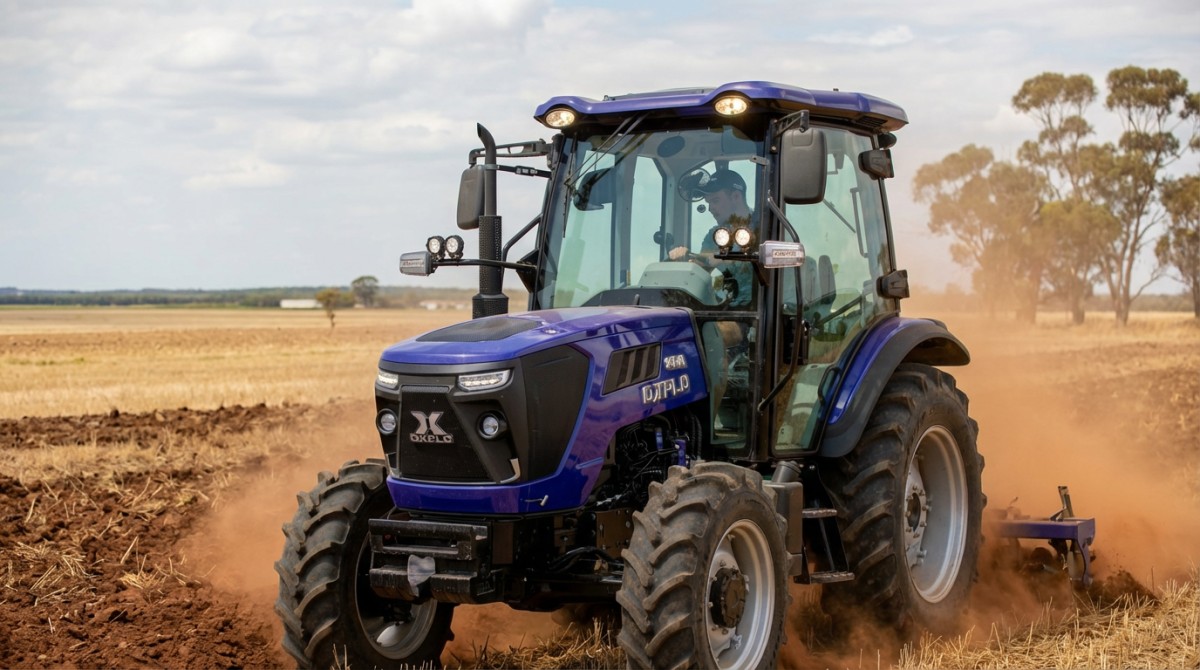
A traditional agricultural tractor still plays an important role in large-scale cropping. But many Australian operators are running livestock farms, lifestyle properties, orchards, or mixed operations where the tractor is expected to do something different every day.
This is where compact utility tractors are becoming essential. Typical tasks include:
Pasture slashing and maintenance
Loader work for feed, fencing materials, and general handling
Orchard and vineyard operations
Property maintenance around buildings and tracks
Post and fence line work
Seasonal support such as firebreak clearing or storm cleanup
In these situations, the advantage of a small tractor is not only maneuverability, but efficiency. The machine can move between open paddocks and tighter working areas without the transport challenges of larger equipment.
Real Capability Comes From System Balance
One of the biggest shifts in tractor development is the understanding that usable performance does not come from engine output alone.
If the transmission is not matched to load variation, or if hydraulic flow cannot support continuous implement use, even a high-horsepower tractor will feel limited. That is why modern compact utility tractors are engineered around system balance — aligning power delivery, structural strength, and hydraulic performance.
For Australian conditions, this balance is especially important. Uneven terrain, long working hours, and frequent implement changes place consistent stress on the machine. At OXPLO, tractors in the compact range are designed with this in mind, so that a small tractor remains stable with a loader fitted, maintains hydraulic responsiveness, and delivers reliable PTO performance under real operating loads.
Why Smaller Tractors Are Taking on Larger Roles
Many operators are finding that a properly engineered small tractor can complete a large share of everyday work that once required a bigger agricultural tractor. The reasons are practical:
Lower fuel and operating costs
Reduced soil disturbance on pasture and maintained areas
Easier transport between properties or job sites
Better access to sheds, yards, and confined areas
Higher overall machine utilization across the year
Instead of owning multiple specialized machines, users increasingly rely on one versatile unit. This shift is a major reason why compact utility tractors have grown rapidly in markets like Australia.
Rethinking What an Agricultural Tractor Means
The meaning of agricultural tractor is gradually expanding. It is no longer defined only by field size or machine dimensions, but by how effectively the tractor supports real, varied working environments.
The evolution of the compact utility tractor shows that capability today comes from engineering integration — structure, power systems, hydraulics, and application matching working together. When these elements are aligned, a small tractor becomes a highly capable working unit.
For manufacturers such as OXPLO, this evolution represents a design approach rather than a trend: building tractors around actual job demands, so that compact machines deliver dependable performance across agricultural, property, and utility tasks.
Share to :
Inquiry
Our manager will contact you within 30 minutes of working hours.
Related products
 TD1004Oxplo, an Australian construction machinery brand, features the 100-horsepower tractor as one of its core products, ideal for small-scale agricultural applications.
 TB804Oxplo, an Australian construction machinery brand, features the 80-horsepower tractor as one of its core products, ideal for small-scale agricultural applications.
 TB704Oxplo, an Australian construction machinery brand, features the 70-horsepower tractor as one of its core products, ideal for small-scale agricultural applications.
 TE504Oxplo, an Australian construction machinery brand, features the 50-horsepower tractor as one of its core products, ideal for small-scale agricultural applications.